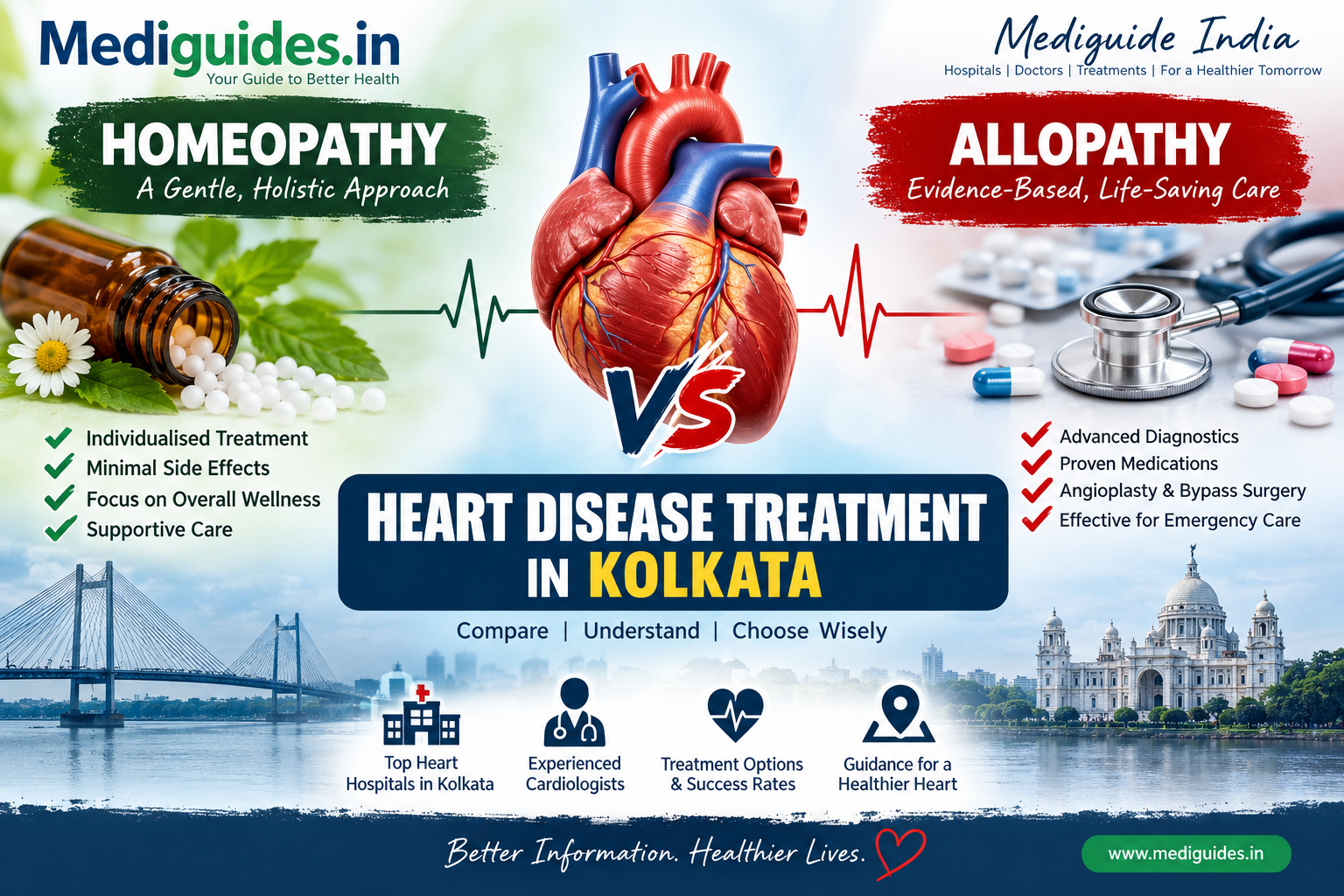
Homeopathy Vs Allopathy For Heart Disease | Treatment & Cardiologists In Kolkata
- 15th September, 2026
- 0 Comments
- 21
- Healthcare

Homeopathy vs Allopathy for Heart Disease: What Should a Patient Choose?
A diagnosis of heart disease often brings anxiety—not only about the condition itself, but also about which treatment to follow.
Should you take medicines for life? Can a heart blockage be treated without surgery? Is homeopathy safer because the medicines are highly diluted? Can homeopathy be taken along with cardiac medicines? And when does a patient actually need angioplasty or bypass surgery?
These are common questions among heart patients and their families.
The answer, however, depends first on understanding one important fact: “heart disease” is not one disease.
It may refer to coronary artery disease caused by narrowed arteries, heart failure, abnormal heart rhythm, valve disease, cardiomyopathy, congenital heart disease, high blood pressure or several other cardiovascular conditions.
The treatment that is appropriate for one heart condition may be completely inappropriate for another.
When serious cardiovascular disease is suspected or diagnosed, treatment decisions therefore need to be based on the specific diagnosis, severity of disease and evidence showing that the treatment can reduce complications.
This is where the difference between homeopathy and conventional—or commonly called “allopathic”—cardiac treatment becomes particularly important.
What Does “Allopathy” Mean in Heart Treatment?
The word allopathy is widely used by patients in India to describe modern medicine.
In medical practice, however, terms such as conventional medicine, modern medicine or evidence-based medicine are more accurate.
Modern cardiology does not simply prescribe medicines for symptoms. It attempts to determine:
What is causing the patient's symptoms?
Is there a blockage in the coronary arteries?
Is the heart pumping normally?
Is there a dangerous rhythm problem?
Are the heart valves functioning correctly?
Is there evidence of a previous or ongoing heart attack?
What is the patient's future cardiovascular risk?
Tests such as an ECG, echocardiogram, blood tests, Holter monitoring, stress testing, CT coronary angiography and conventional coronary angiography may be used depending on the patient's symptoms and clinical condition.
Once the exact problem is identified, treatment can be targeted accordingly.
What Is Homeopathy?
Homeopathy is a system of medicine developed more than two centuries ago.
Its principles include the concept of “like cures like” and the use of substances prepared through repeated dilution.
Homeopathic treatments are generally individualised, meaning two people reporting similar symptoms may receive different preparations.
Some patients seek homeopathy for problems such as:
Palpitations
Stress or anxiety
Mild chest discomfort
High blood pressure
Weakness or fatigue
Breathlessness
General wellbeing
But there is an important difference between reducing how a patient feels a symptom and treating the cardiovascular disease responsible for that symptom.
According to the U.S. National Center for Complementary and Integrative Health (NCCIH), there is little evidence supporting homeopathy as an effective treatment for any specific health condition. NCCIH also notes that some products marketed as homeopathic can contain measurable active ingredients and may produce side effects or drug interactions.
That distinction becomes particularly important when dealing with diseases capable of causing heart attack, stroke, heart failure or sudden cardiac death.
Can Homeopathy Treat Heart Disease?
At present, reliable scientific evidence has not demonstrated that homeopathy can replace established treatment for serious cardiovascular disease.
For example, there is no convincing evidence that homeopathy can:
Open a severely blocked coronary artery
Atherosclerotic plaque physically narrows the blood vessels supplying the heart. Depending on the severity and clinical situation, treatment may involve lifestyle changes, medications, angioplasty with stenting or bypass surgery.
Stop an ongoing heart attack
A heart attack usually occurs when blood supply to part of the heart muscle becomes suddenly obstructed. Rapid restoration of blood flow can be critical.
Repair a severely damaged heart valve
Severe valve disease may eventually require surgical valve repair, valve replacement or catheter-based intervention.
Correct a dangerous cardiac arrhythmia
Certain arrhythmias require anti-arrhythmic medicines, electrical cardioversion, catheter ablation, pacemakers or implantable defibrillators.
Replace evidence-based treatment for heart failure
Heart failure management can involve several medications, lifestyle modifications, cardiac rehabilitation and, for selected patients, pacemakers, ICDs, CRT devices or surgery.
This does not mean that every person with heart disease requires an operation. Many cardiac conditions can be managed effectively with medicines and lifestyle modification.
The key point is that treatment should be determined by the disease—not simply by the medical system a patient prefers.
Homeopathy vs Allopathy for Heart Disease: A Practical Comparison
| Question | Homeopathy | Modern / Conventional Cardiology |
|---|---|---|
| Can it diagnose a coronary blockage? | No | CT coronary angiography or coronary angiography can identify blockages |
| Proven treatment for a heart attack? | No reliable evidence | Yes |
| Can significantly blocked arteries be treated? | No evidence of removing major blockage | Medicines, angioplasty or bypass surgery depending on the case |
| Treatment for heart failure | No established disease-modifying role | Medicines, rehabilitation, devices and procedures |
| Treatment for serious arrhythmia | Not established | Medicines, cardioversion, ablation, pacemaker or ICD where appropriate |
| Severe heart-valve disease | Cannot mechanically repair a valve | Valve repair/replacement or catheter-based procedures may be considered |
| Evidence from cardiovascular clinical trials | Limited/insufficient | Extensive |
| Can treatment be individualised? | Yes | Yes |
| Role in emergency heart treatment | Should not replace emergency care | Essential |
| Possible complementary role | Only after discussion with treating doctor | Remains the primary treatment for established cardiovascular disease |
Heart Blockage: Can Homeopathy Remove a Blockage?
This is one of the most frequently searched questions about alternative treatment for heart disease.
A heart blockage, in everyday language, usually refers to narrowing of one or more coronary arteries due to atherosclerosis.
Atherosclerosis develops when cholesterol-containing plaque accumulates within the arterial wall.
The important question is not simply:
“Do I have a blockage?”
The cardiologist also needs to know:
Where is the blockage?
How severe is it?
Is blood flow being significantly restricted?
Is the patient experiencing angina?
How many arteries are involved?
Is the left main coronary artery involved?
Is heart function reduced?
Does the patient have diabetes or other major risk factors?
Not every coronary blockage requires a stent.
Some patients can be managed with appropriate medications, cholesterol control, blood-pressure management, diabetes control, smoking cessation, diet and exercise.
Other patients may benefit from angioplasty.
Patients with certain patterns of extensive coronary artery disease may be advised to undergo coronary artery bypass grafting or CABG.
The appropriate treatment cannot be decided purely by the percentage of blockage seen on a report.
Can homeopathy dissolve coronary plaque?
There is currently no reliable clinical evidence demonstrating that homeopathic treatment can dissolve a clinically important coronary blockage or substitute for angioplasty, bypass surgery or evidence-based medical therapy when these are indicated.
A patient with known coronary disease should therefore not stop cardiac treatment in an attempt to treat the blockage exclusively through homeopathy.
Homeopathy vs Allopathy for Heart Failure
Heart failure is often misunderstood.
It does not necessarily mean that the heart has stopped working.
It means that the heart is not pumping or filling as efficiently as the body requires.
Patients may experience:
Breathlessness
Reduced exercise capacity
Swelling of the legs or ankles
Unusual tiredness
Difficulty breathing while lying flat
Rapid weight gain due to fluid retention
Persistent coughing or wheezing
Treatment depends on the type and cause of heart failure.
Modern treatment can include lifestyle management, medications, treatment of coronary artery disease or valve disease, cardiac rehabilitation and, in selected patients, implantable devices.
The American Heart Association describes heart-failure treatment as potentially including lifestyle changes, medicines, cardiac rehabilitation, devices and surgery depending on the patient's condition.
Some patients with severe heart failure or dangerous arrhythmias may require an implantable cardioverter-defibrillator (ICD). Others may benefit from cardiac resynchronisation therapy (CRT).
Homeopathy has not been demonstrated to replace these therapies.
What About High Blood Pressure?
High blood pressure deserves special attention because a person can have hypertension for years without feeling ill.
Untreated or inadequately controlled hypertension can increase the risk of:
Heart attack
Stroke
Heart failure
Kidney disease
Vascular disease
A person should therefore not judge whether blood-pressure treatment is working simply by asking, “Do I feel better?”
Blood pressure needs to be measured.
Management may involve weight reduction, appropriate physical activity, reducing excess sodium, better sleep, stopping smoking, controlling diabetes and medication when indicated.
Patients already taking antihypertensive medicines should not stop them because their blood pressure has become normal. The normal reading may be the result of the treatment working.
Can Homeopathy Be Taken Along With Heart Medicines?
Patients sometimes prefer to continue homeopathy while receiving treatment from a cardiologist.
The first rule should be transparency.
Tell your cardiologist about every product you are taking, including:
Homeopathic products
Ayurvedic preparations
Herbal supplements
Vitamins and minerals
Protein or fitness supplements
Over-the-counter medicines
NCCIH cautions that some products labelled as homeopathic may contain substantial amounts of active ingredients and can potentially cause adverse effects or interact with medicines.
Complementary medicine should therefore mean “alongside appropriate medical care,” not “instead of necessary medical care.”
The American Heart Association similarly advises people with heart failure to discuss complementary and alternative products with their healthcare professionals because of possible safety concerns and interactions.
Never Stop Heart Medicines Without Speaking to Your Doctor
This is particularly important.
Patients should not independently discontinue medicines prescribed after a heart attack, angioplasty, bypass surgery or diagnosis of heart failure.
Depending on the patient's condition, cardiac medicines may include treatment to:
Prevent blood clots
Reduce cholesterol
Control blood pressure
Reduce the heart's workload
Control abnormal rhythm
Remove excess fluid
Improve heart-failure outcomes
Stopping some medicines suddenly can increase the risk of serious complications.
A treatment change should therefore be discussed with the treating cardiologist.
When Is Angioplasty Needed?
Angioplasty—or percutaneous coronary intervention (PCI)—is a minimally invasive procedure in which a catheter is used to treat a narrowed coronary artery.
A small balloon may be inflated within the narrowed portion of the vessel, and a stent is commonly placed to help keep the artery open.
However, the presence of a blockage does not automatically mean angioplasty is required.
The decision may depend on:
Severity and location of disease
Patient's symptoms
Whether the situation is an emergency
Results of functional testing
Number of coronary arteries involved
Heart-pumping function
Diabetes and other health conditions
Previous cardiac procedures
Treatment should therefore be personalised after appropriate cardiology evaluation.
When Is Bypass Surgery Considered?
Coronary artery bypass grafting (CABG) creates an alternative route for blood to reach heart muscle beyond blocked coronary arteries.
Surgeons use blood vessels from elsewhere in the patient's body to bypass the narrowed areas.
CABG may be considered in selected patients with complex or extensive coronary artery disease.
Modern cardiac surgery may also include conventional CABG as well as minimally invasive techniques in suitable patients.
The choice between medicines, angioplasty and bypass surgery should ideally be based on the patient's complete clinical picture rather than fear of a particular procedure.
Heart Disease Treatment Is More Than Medicines or Surgery
One mistake patients sometimes make is to think modern heart treatment means only tablets, stents or operations.
Lifestyle treatment remains fundamental.
Important areas include:
Smoking cessation: Tobacco significantly increases cardiovascular risk.
Cholesterol management: LDL cholesterol plays an important role in the development of atherosclerotic cardiovascular disease.
Blood-pressure control: Persistent hypertension places additional strain on the heart and blood vessels.
Diabetes management: Diabetes substantially increases cardiovascular risk.
Exercise: The amount and intensity should be appropriate for the patient's condition.
Nutrition: A heart-healthy diet generally emphasises vegetables, fruits, whole grains, legumes and appropriate sources of protein while limiting excessive sodium, refined foods and unhealthy fats.
Weight management: Where appropriate, gradual and sustainable weight reduction can improve several cardiovascular risk factors.
Sleep: Conditions such as obstructive sleep apnoea may contribute to cardiovascular problems.
Cardiac rehabilitation: This is particularly valuable after certain cardiac events and procedures.
The American Heart Association describes cardiac rehabilitation as a medically supervised programme combining exercise training, heart-health education and support following conditions such as heart attack, heart failure, angioplasty or heart surgery.
When Should You See a Cardiologist?
Do not wait for severe chest pain before thinking about heart health.
A cardiology evaluation may be appropriate if you have persistent or unexplained:
Chest pressure or discomfort
Breathlessness
Palpitations
Reduced exercise tolerance
Unusual tiredness
Dizziness
Fainting
Swelling of the feet
Very high blood pressure
People with significant risk factors may also require cardiovascular assessment even if they currently feel well.
These risk factors include diabetes, hypertension, high cholesterol, smoking, obesity and a strong family history of premature cardiovascular disease.
Heart Attack Warning Signs: When You Should Not Wait
A possible heart attack is not the time to compare homeopathy with allopathy.
Seek emergency medical assistance immediately if a person develops symptoms such as:
Pressure, squeezing, heaviness or pain in the chest
particularly if it continues for several minutes or repeatedly returns.
Other warning symptoms may include:
Pain or discomfort spreading to the arm, shoulder, back, neck or jaw
Shortness of breath
Cold sweating
Nausea
Sudden light-headedness or faintness
Unusual severe weakness or fatigue
Heart attacks do not always begin with dramatic pain. Some develop gradually with comparatively mild discomfort.
The American Heart Association emphasises that heart-attack symptoms may vary and that rapid medical attention is important because minutes matter.
Heart Disease Treatment in Kolkata: Hospitals and Cardiologists
Kolkata has several hospitals providing advanced cardiac diagnostics, interventional cardiology, electrophysiology and cardiothoracic surgery.
The hospitals and doctors below are provided for patient information, not as a ranking or endorsement. Doctor affiliations and consultation schedules can change, so always confirm directly with the hospital before booking.
1. Apollo Multispeciality Hospitals, Kolkata
Apollo Multispeciality Hospitals on the EM Bypass provides cardiology, interventional cardiology and cardiothoracic surgery services.
Some cardiologists currently listed by Apollo include:
Dr. Sumanto Mukhopadhyay
Structural Heart Intervention Specialist & Senior Consultant, Interventional Cardiology
Dr. A. K. Bardhan
Senior Interventional Cardiologist
Dr. Aftab Khan
Cardiologist with interventional cardiology/electrophysiology practice
Apollo also lists cardiothoracic surgeons and other cardiac specialists as part of its Kolkata clinical team.
2. Fortis Hospital, Anandapur, Kolkata
Fortis Anandapur provides cardiac sciences services including interventional cardiology and cardiothoracic vascular surgery.
Some doctors currently listed by Fortis include:
Dr. Shuvanan Ray
Director – Cardiology
Dr. Ashok Dhar
Senior Consultant – Cardiology
Dr. Kayapanda Muthana Mandana
Director – Cardiothoracic Vascular Surgery
Fortis also lists several consultant cardiologists and cardiac surgeons at its Anandapur facility.
3. BM Birla Heart Hospital, Kolkata
BM Birla Heart Hospital is a dedicated cardiac-care hospital in Kolkata offering cardiology, interventional cardiology and cardiothoracic surgical services.
Doctors currently listed by the hospital include:
Dr. Anjan Siotia
Director – Cardiology
Dr. Dhiman Kahali
Director – Interventional Cardiology
Dr. Anil Mishra
Director – Cardiology
The hospital also has specialists in cardiac surgery and related cardiovascular disciplines.
4. Manipal Hospitals, Dhakuria
Manipal Hospitals Dhakuria provides cardiology services including evaluation and treatment of coronary artery disease, structural heart disease and rhythm disorders.
Some specialists currently listed by Manipal include:
Prof. Dr. Monotosh Panja
Senior Consultant – Cardiologist
Dr. Pradip Bhowmik
Consultant – Cardiology
Dr. Saumitra Ray
Consultant – Cardiology
Manipal's official information also lists interventional cardiac services such as angioplasty, stent placement and treatment of selected structural and rhythm disorders.
What About Homeopathy Treatment in Kolkata?
For patients specifically seeking homeopathic consultation, Kolkata is also home to the National Institute of Homoeopathy (NIH) in Salt Lake.
NIH is an autonomous institution under the Ministry of Ayush, Government of India, involved in homeopathic education, patient care and research. Its Kolkata campus is located in Sector III, Salt Lake.
However, the existence of a recognised homeopathic institution should not be interpreted as evidence that homeopathy can replace cardiology treatment for coronary artery disease, heart attack, heart failure, serious arrhythmias or severe valve disease.
A person seeking complementary homeopathic treatment for general wellbeing should continue appropriate cardiac evaluation and treatment.
How to Choose a Heart Doctor in Kolkata
Instead of searching only for the “best cardiologist in Kolkata,” consider what type of specialist your condition actually requires.
For example:
General/Clinical Cardiologist:
Evaluation and medical management of cardiovascular diseases.
Interventional Cardiologist:
Specialises in procedures such as coronary angiography, angioplasty and stenting.
Electrophysiologist:
Specialises in abnormal heart rhythms and procedures such as electrophysiology studies and ablation.
Cardiothoracic or Cardiac Surgeon:
Performs procedures such as bypass surgery and valve operations.
Heart Failure Specialist:
Focuses on patients with complex or advanced heart failure.
A good hospital should also have access to appropriate emergency care, cardiac imaging, catheterisation facilities, intensive care and cardiac surgery when required.
Homeopathy or Allopathy: Which Is Safer for a Heart Patient?
The better question is:
“Which treatment has been shown to address the specific heart problem I have?”
If someone has stress-related palpitations but a cardiac evaluation shows no dangerous heart condition, treatment may be very different from someone with a 90% coronary blockage.
Likewise, mild hypertension is not treated in the same way as acute heart failure.
For established cardiovascular disease, evidence-based cardiology should remain the foundation of treatment.
Homeopathy has not demonstrated the ability to replace treatments that restore blood flow during a heart attack, prevent dangerous cardiovascular events, repair diseased valves or treat serious rhythm disorders.
A patient who wishes to use homeopathy as complementary care should discuss it openly with the treating cardiologist.
Frequently Asked Questions About Homeopathy and Heart Disease
1. Can homeopathy cure heart blockage?
There is no reliable scientific evidence that homeopathy can remove a significant coronary artery blockage.
Treatment depends on the severity and location of disease and may include lifestyle changes, medicines, angioplasty or bypass surgery.
2. Can a 70% or 80% heart blockage be treated without surgery?
Sometimes, but the percentage alone is not enough to determine treatment.
A cardiologist considers the location of the blockage, symptoms, blood flow, number of vessels involved, heart function and the patient's overall medical condition.
Not every 70% blockage automatically requires a stent, and not every severe blockage can safely be ignored.
3. Is homeopathy safe for heart patients?
It should not automatically be assumed to be completely harmless.
Some products labelled as homeopathic may contain active ingredients capable of causing adverse effects or interacting with other medicines.
Tell your cardiologist about everything you take.
4. Can I take homeopathy after angioplasty?
Do not stop medicines prescribed after angioplasty in order to take homeopathy.
If you want to use a complementary treatment, discuss the specific product with your cardiologist first.
Medicines prescribed after coronary stenting can be particularly important for preventing complications.
5. Can homeopathy prevent bypass surgery?
There is no evidence that homeopathy can substitute for CABG when bypass surgery is medically indicated.
However, not every patient with coronary artery disease needs surgery. The decision should be made after proper cardiac evaluation.
6. Can diet reverse heart blockage naturally?
Diet and lifestyle modification are extremely important and can substantially improve cardiovascular risk.
However, patients with established coronary artery disease should not assume that diet alone has made a dangerous blockage disappear.
Follow-up and appropriate medical treatment remain important.
7. Does everyone with heart disease need lifelong medicine?
Not necessarily every medicine for every patient.
However, many cardiovascular conditions require long-term risk reduction and follow-up.
Whether a medicine can be reduced or stopped depends on the patient's diagnosis, response to treatment and cardiovascular risk.
The decision should be made with the treating doctor.
8. What is the best test for heart blockage?
There is no single “best” test for everyone.
Depending on symptoms and risk, a cardiologist may recommend an ECG, echocardiogram, exercise/stress testing, CT coronary angiography or invasive coronary angiography.
The correct investigation depends on the individual patient.
9. Should I consult a cardiologist even if my ECG is normal?
Possibly.
A normal resting ECG does not rule out every form of heart disease.
If symptoms such as exertional chest discomfort, unexplained breathlessness or recurrent palpitations persist, further evaluation may be necessary.
10. Which treatment is better for heart disease—homeopathy or allopathy?
For diagnosed cardiovascular diseases such as coronary artery disease, heart attack, heart failure, serious arrhythmia or significant valve disease, modern evidence-based cardiology has established diagnostic and treatment options supported by clinical research.
Homeopathy has not been demonstrated to replace these treatments.
Final Takeaway
The choice between homeopathy and allopathy for heart disease should not be treated like choosing between two brands of medicine.
Heart disease can involve the blood vessels, heart muscle, electrical system or valves—and some cardiovascular problems can become life-threatening very quickly.
Modern cardiology allows doctors to identify the exact problem and decide whether the patient requires lifestyle changes, medicines, cardiac rehabilitation, angioplasty, rhythm treatment, valve intervention or surgery.
Homeopathy may be something individual patients choose to explore as complementary care, but it should not delay diagnosis or replace evidence-based treatment for established cardiovascular disease.
If you experience persistent chest discomfort, unexplained breathlessness, palpitations, fainting, swelling of the feet or declining exercise capacity, consult a qualified doctor or cardiologist.
And if chest pain is accompanied by sweating, severe breathlessness, pain spreading to the arm or jaw, dizziness or collapse, seek emergency medical care immediately.
Medical Disclaimer
This article is intended for general health education and should not be used for self-diagnosis or as a substitute for consultation with a qualified medical professional. Treatment recommendations vary according to the patient's diagnosis, age, medical history, investigations and overall health.
Hospital and doctor information was checked against official hospital sources in September 2026. Affiliations and consultation schedules may change; patients should confirm directly with the hospital before booking an appointment. Mediguide India: +918001700199






No Comments For Now.