Common Orthopedic Diseases In Children: Symptoms, Treatment & Pediatric Orthopedic Doctors In Kolkata
- 15th September, 2026
- 0 Comments
- 18
- Healthcare

Orthopedic Problems in Children Are Different From Adults
When a child complains of leg pain, walks differently, develops bowed legs or suffers a fracture, parents often wonder whether the problem will disappear naturally as the child grows.
Sometimes it does.
But sometimes an apparently minor problem may involve the child's growth plate, hip joint, spine, muscles or developing bones, and delaying treatment can make correction more difficult later.
Pediatric orthopedics is therefore not simply adult orthopedics for smaller patients.
Children's bones are still growing. They heal differently from adult bones, their joints continue to develop, and injuries near a growth plate can potentially influence future limb growth. Specialist pediatric orthopedic care focuses not only on treating today's problem but also on protecting the child's future growth, mobility and function.
Hospitals in Kolkata now provide dedicated pediatric orthopedic services for conditions ranging from clubfoot and developmental hip problems to fractures, cerebral palsy, scoliosis and complex limb deformities. (Apollo Hospitals)
What Is Pediatric Orthopedics?
Pediatric orthopedics is a branch of orthopedic surgery dealing with bone, joint, muscle, ligament and limb-development problems in babies, children and adolescents.
A pediatric orthopedic specialist may treat conditions that are:
Present from birth
Related to growth and development
Caused by injury
Associated with neurological diseases
Caused by bone or joint infections
Related to sports
Related to abnormal growth of a limb or spine
Because a child's skeleton changes continuously during growth, early diagnosis can sometimes allow treatment with casting, braces, physiotherapy or guided growth, avoiding more extensive surgery later.
Common Orthopedic Diseases in Children
1. Clubfoot or CTEV
Clubfoot, medically known as Congenital Talipes Equinovarus or CTEV, is a congenital condition in which one or both feet are turned inward and downward.
It is usually noticeable soon after birth.
The baby's foot may appear:
Turned inward
Pointed downward
Smaller than the opposite foot when only one side is affected
Stiff and difficult to move into a normal position
How Is Clubfoot Treated?
The most widely used treatment is the Ponseti method.
This involves gentle manipulation of the foot followed by a series of casts that gradually correct the deformity. Many babies also require a small procedure called an Achilles tenotomy, followed by bracing to help maintain the correction.
The Pediatric Orthopaedic Society of North America notes that Ponseti serial casting is a preferred treatment approach for idiopathic clubfoot, with bracing playing a major role in preventing recurrence. (POSNA)
Treatment is generally easier when it begins early.
Parents should also understand that completing the casting phase is not the end of treatment. Following the prescribed brace schedule is extremely important because clubfoot can recur.
2. Developmental Dysplasia of the Hip — DDH
Developmental Dysplasia of the Hip (DDH) occurs when a baby's hip joint does not develop normally.
The ball at the top of the thighbone may be loose within the hip socket or, in more severe cases, partially or completely dislocated.
Some babies do not show obvious symptoms.
Possible warning signs include:
Unequal leg lengths
Uneven skin folds around the thighs
Reduced movement of one hip
Difficulty spreading the legs during diaper changes
Limping after the child starts walking
Early diagnosis is particularly important.
Infants with certain forms of DDH may be treated using a special brace such as a Pavlik harness, while older babies or more severe cases may require reduction, casting or surgery. Evidence-based pediatric orthopedic guidelines specifically address early detection and nonsurgical management of DDH in infants. (POSNA)
This is one reason routine newborn and infant examinations are important even when the baby appears healthy.
3. Bow Legs in Children
Bow legs, or genu varum, means the knees remain apart when the child stands with the feet together.
A degree of bowing can be normal in infants and young toddlers.
As children grow, their leg alignment usually changes naturally.
However, orthopedic evaluation may be needed when:
Bowing is severe
Only one leg is affected
The deformity becomes worse rather than better
The child has pain
Growth appears abnormal
Bowing persists beyond the age when natural correction would normally be expected
Certain metabolic, developmental or skeletal disorders can also cause persistent bow legs.
Treatment depends entirely on the cause.
Some children require only observation, while others may need treatment for an underlying condition, bracing or corrective surgery.
4. Knock Knees
Knock knees, or genu valgum, occur when the knees touch while the ankles remain separated.
Like bow legs, some knock-knee alignment can be part of normal childhood development.
Parents should seek orthopedic advice if the deformity is:
Severe
Painful
Asymmetric
Progressively worsening
Affecting walking or running
Continuing unusually late in childhood
In selected children with significant deformity and remaining growth, pediatric orthopedic surgeons may use guided-growth procedures to gradually correct alignment as the child grows.
5. Flat Feet in Children
Parents frequently become concerned when their child's feet appear flat.
However, flexible flat feet are common in young children.
The arch may appear when the child sits or stands on tiptoe but disappear while standing normally.
Many painless flexible flat feet require no treatment.
A pediatric orthopedic evaluation becomes more important when flat feet are associated with:
Persistent pain
Stiffness
Recurrent ankle problems
Difficulty walking or running
An unusually rigid foot
Significant asymmetry
Treatment may involve observation, activity modification, footwear advice, stretching or orthotics for selected symptomatic children.
Surgery is uncommon for ordinary painless flexible flat feet.
6. Fractures in Children
Falls from playground equipment, bicycles, beds, sports and everyday accidents make fractures one of the common reasons children require orthopedic care.
But children's fractures are different from adult fractures because of the presence of growth plates.
The growth plate is an area near the end of a developing bone responsible for future bone growth.
A fracture involving this area sometimes requires careful monitoring to make sure subsequent growth remains normal.
Treatment may include:
Splinting
Casting
Closed reduction
Pins
Flexible nails
Plates and screws
External fixation in selected complex injuries
The treatment depends heavily on the child's age, fracture location and fracture pattern. For example, AAOS guidance notes that treatment of femur fractures in children varies according to age, weight, fracture characteristics and associated injuries. (OrthoInfo)
Many children's fractures heal very well, but this should not be interpreted to mean that every fracture can simply be left to heal on its own.
7. Elbow Fractures in Children
An especially important injury in children is the supracondylar fracture of the humerus, which usually occurs near the elbow after a fall.
Warning signs include:
Severe elbow pain
Swelling
Inability to move the elbow
Visible deformity
Tingling or numbness
A pale or cold hand
AAOS identifies supracondylar humerus fractures as common childhood elbow injuries. A displaced fracture may require reduction and pin fixation, while problems with blood flow or nerves can make treatment urgent. (OrthoInfo)
A pale or cold hand after an elbow injury requires immediate medical attention.
8. Scoliosis in Children and Teenagers
Scoliosis is an abnormal sideways curvature of the spine.
It often becomes noticeable around the adolescent growth spurt.
Parents may notice:
One shoulder appearing higher
One shoulder blade sticking out more
Uneven waistline
One hip appearing higher
The body leaning to one side
AAOS describes scoliosis as a sideways spinal curve that may resemble an “S” or “C.” Many mild curves only require observation, whereas larger or progressive curves can require bracing or surgery. (OrthoInfo)
Early assessment can be particularly useful because the amount of growth remaining influences treatment decisions.
9. Cerebral Palsy and Orthopedic Problems
Cerebral palsy primarily affects movement and muscle control, but it can also cause significant orthopedic problems as children grow.
These may include:
Muscle tightness
Toe walking
Hip displacement
Knee contractures
Foot deformity
Abnormal gait
Scoliosis
Treatment is usually multidisciplinary.
Depending on the child, it may include:
Physiotherapy
Stretching programmes
Braces or orthoses
Medicines to reduce spasticity
Botulinum toxin in selected situations
Mobility aids
Tendon or muscle surgery
Hip reconstruction
Bone correction surgery
The goal is not simply to make an X-ray appear normal. Treatment should ideally improve comfort, sitting, standing, walking, hygiene and overall function.
Neotia Bhagirathi's pediatric orthopedic service specifically lists cerebral palsy and neuromuscular disorders among the conditions treated. (Neotia Hospital)
10. Perthes Disease
Legg-Calvé-Perthes disease affects the hip in children when blood supply to the developing femoral head is temporarily disrupted.
Children may develop:
Limping
Hip pain
Groin pain
Thigh or knee pain
Reduced hip movement
One unusual feature is that some children complain primarily of knee pain even though the actual problem is in the hip.
Treatment depends on the child's age and the severity of hip involvement.
It may include activity modification, physiotherapy, monitoring and, in selected cases, surgery designed to keep the femoral head well positioned within the hip socket during healing.
11. Slipped Capital Femoral Epiphysis — SCFE
Slipped Capital Femoral Epiphysis (SCFE) is an important hip problem generally seen in older children and adolescents.
The growth plate near the top of the thighbone becomes unstable, allowing part of the femoral head to slip.
Symptoms can include:
Hip or groin pain
Knee pain
Limping
Foot turning outward
Difficulty walking
A child with suspected SCFE should be evaluated promptly.
Unlike ordinary growing pains, SCFE can require urgent surgical stabilization to prevent further slipping and complications.
Neotia Bhagirathi's pediatric orthopedic programme lists both SCFE and Perthes disease among its dedicated clinical areas. (Neotia Hospital)
12. Limb-Length Difference and Limb Deformity
Some children are born with one limb shorter than the other, while others develop a difference because of:
Previous fracture
Growth-plate injury
Infection
Congenital abnormalities
Neurological disease
A small difference may cause little or no difficulty.
Larger differences can affect:
Walking
Pelvic alignment
Posture
Spine alignment
Treatment can range from observation and shoe lifts to guided growth, limb-lengthening or other reconstructive procedures.
The child's age and projected difference at skeletal maturity are important when deciding treatment.
13. Bone and Joint Infections
Children can develop infections involving bones or joints.
Symptoms may include:
Fever
Severe localized pain
Swelling
Refusing to walk
Refusing to move an arm or leg
Unexplained irritability in a baby
Bone infection is known as osteomyelitis, while infection within a joint is known as septic arthritis.
These conditions require prompt medical assessment.
Treatment may include antibiotics and, in some cases, surgical drainage.
A child who suddenly refuses to stand or walk while also having fever should not simply be assumed to have suffered a minor sprain.
14. Pediatric Sports Injuries
Children are increasingly involved in football, cricket, swimming, athletics, gymnastics, dance and other organised sports.
Sports injuries can involve:
Ligaments
Tendons
Growth plates
Knees
Ankles
Shoulders
Stress injuries
Overuse injuries can develop when training load increases faster than the child's body can adapt.
Bone stress injuries, for example, can initially produce pain only during activity but may eventually progress to pain during normal walking or even at rest if ignored. (OrthoInfo)
Persistent sports-related pain should therefore not always be dismissed as normal soreness.
What Are “Growing Pains”?
Not every episode of leg pain in childhood represents disease.
Typical growing pains generally:
Affect both legs
Occur later in the day or at night
Do not cause visible swelling
Do not usually produce a limp
Are gone by the following morning
However, parents should seek medical advice when pain:
Affects only one specific area repeatedly
Is associated with swelling
Causes limping
Occurs with fever
Wakes the child frequently
Progressively worsens
Is associated with weakness or weight loss
Persistent pain deserves investigation rather than automatically being labelled “growing pain.”
How Are Pediatric Orthopedic Problems Diagnosed?
Diagnosis starts with taking a careful history and physically examining the child.
The specialist may assess:
Walking pattern or gait
Limb alignment
Muscle strength
Joint movement
Hip stability
Spine alignment
Leg lengths
Foot position
Neurological function
Depending on the problem, investigations may include:
X-ray
Useful for fractures, deformity, hip conditions and scoliosis.
Ultrasound
Often particularly useful for assessing infant hips.
MRI
Provides detailed images of bones, cartilage, ligaments, muscles and other soft tissues.
CT Scan
May be useful for certain complex fractures or deformities.
Blood Tests
Can be necessary when infection, inflammation or metabolic bone disease is suspected.
Not every child requires extensive scans. The appropriate investigation depends on the suspected condition.
Treatment of Pediatric Orthopedic Diseases
One of the most important things parents should know is that seeing a pediatric orthopedic surgeon does not automatically mean the child needs surgery.
Many conditions are treated without an operation.
Observation
Certain developmental conditions improve naturally and only require monitoring.
Physiotherapy
Physiotherapy may help improve:
Strength
Flexibility
Balance
Walking
Joint movement
Recovery after an injury or operation
Casting
Casts can be used for fractures and for gradual correction of deformities such as clubfoot.
Braces and Orthoses
Braces may be used for:
Clubfoot
Scoliosis
Neuromuscular disorders
Selected foot and limb problems
Guided Growth
Small implants can sometimes be used around a child's growth plate to gradually correct angular deformities such as significant knock knees while the child continues growing.
Surgery
Surgery may be required for conditions such as:
Severely displaced fractures
Progressive limb deformities
Significant hip dysplasia
Certain cerebral palsy-related deformities
Severe scoliosis
SCFE
Complex congenital limb abnormalities
The aim of treatment is generally to achieve the safest possible correction while preserving growth and function.
When Should Parents Consult a Pediatric Orthopedic Specialist?
Consider consulting a pediatric orthopedic doctor when your child has:
A visible limb deformity
Persistent limping
Recurrent bone or joint pain
A suspected fracture
Bow legs or knock knees that appear excessive
A foot turned inward or outward
Significant flat-foot pain
Unequal leg lengths
An abnormal walking pattern
Persistent toe walking
Uneven shoulders or suspected scoliosis
Hip movement abnormalities in infancy
Orthopedic difficulties associated with cerebral palsy
Early assessment does not necessarily mean early surgery.
In many pediatric orthopedic conditions, early diagnosis actually increases the possibility of simpler, non-surgical treatment.
Pediatric Orthopedic Doctors in Kolkata
The following names are provided for informational purposes rather than as a ranking of the “best” pediatric orthopedic surgeons. Affiliations and consultation schedules may change, so parents should confirm directly with the hospital before visiting.
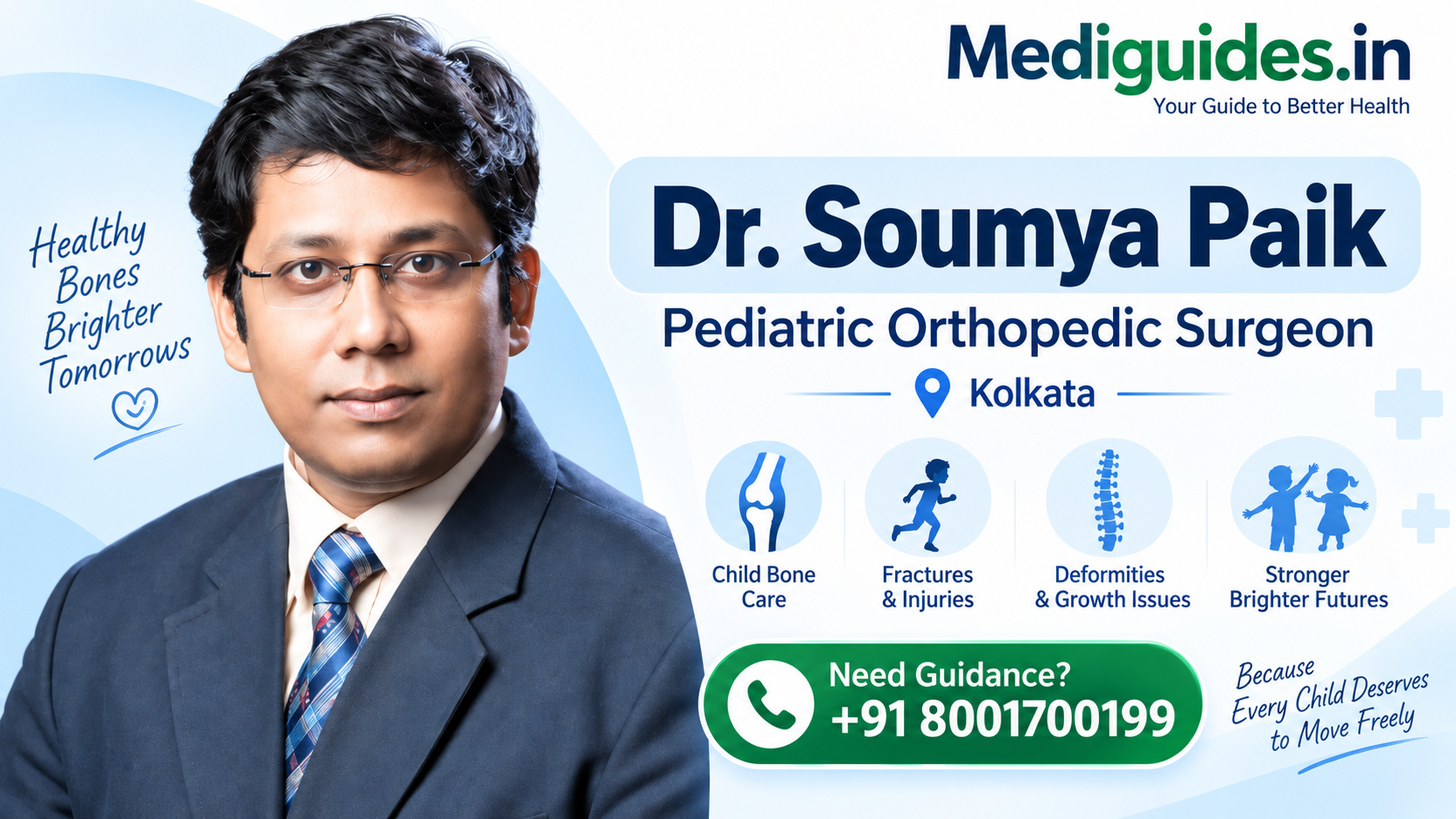
Dr. Soumya Paik — Pediatric Orthopedics
Dr. Soumya Paik is a pediatric orthopedic specialist currently listed by both Apollo Multispeciality Hospitals and Neotia Bhagirathi Woman and Child Care Centre.
His qualifications include MBBS, MS Orthopaedics and DNB Orthopaedics, and Neotia lists his Fellowship in Pediatric Orthopaedics from the National University Hospital, Singapore. Apollo currently lists more than 15 years of experience in pediatric orthopedics. (Apollo Hospitals)
His clinical work includes congenital deformities, pediatric trauma and other musculoskeletal problems affecting growing children.
He also runs Kids Orthopedic Clinic: Dr. Soumya Paik in New Town. His clinic information lists services covering fractures, clubfoot, newborn orthopedic screening, bow legs, knock knees and other pediatric musculoskeletal disorders. (Kids Orthopedic Clinic)
Dr. Abhishek Nandi — Pediatric Orthopedics
Dr. Abhishek Nandi is currently listed in pediatric orthopedics by Apollo, Desun Hospital and Neotia Bhagirathi.
Apollo lists his training as MS Orthopaedics from JIPMER, Fellowship in Pediatric Orthopaedics from CMC Vellore, followed by postdoctoral pediatric orthopedic training.
His listed clinical areas include:
Pediatric fractures
Bone and joint infections
Deformity correction
Bone tumours
Cerebral palsy
Limb reconstruction
Dr. Abhishek NK Saha — Pediatric Orthopedics
Dr. Abhishek NK Saha is listed as Consultant – Paediatric Orthopaedic Specialist at Manipal Hospitals, Mukundapur.
His qualifications listed by Manipal include MBBS, DNB Orthopaedics, Diploma in Orthopaedics and MS Orthopaedics, along with pediatric orthopedic fellowship training.
Manipal lists areas of work including:
Cerebral palsy
Limb lengthening
Complex pediatric orthopedic surgery
Pediatric hip and knee problems
Dr. Suhas Ranjan Bala — Pediatric Orthopedics
Neotia Bhagirathi Woman and Child Care Centre, New Town currently lists Dr. Suhas Ranjan Bala under Pediatric Orthopaedics, with qualifications including MBBS, D.Ortho and MS Orthopaedics. (Neotia Hospital)
Pediatric Orthopedic Hospitals in Kolkata
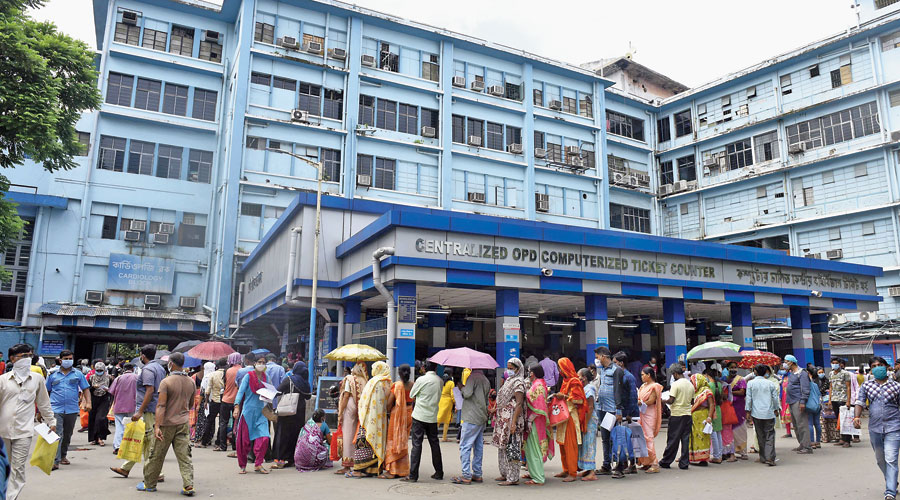
Apollo Multispeciality Hospitals
Apollo Multispeciality Hospitals
Apollo Multispeciality Hospitals Address: 58, Canal Circular Rd, Kadapara, Phoolbagan, Kankurgachi, Kolkata, West Bengal 700054, India
Apollo's children's centre provides multiple pediatric specialties under one roof, including Pediatric Orthopaedics, Pediatric Neurology, Pediatric Surgery, Neonatal Medicine and Pediatric Intensive Care. (Apollo Hospitals)
This multidisciplinary setup can be particularly useful when a child's orthopedic problem is connected with another medical or neurological condition.
Neotia Bhagirathi Woman and Child Care Centre, New Town
Neotia Bhagirathi Woman and Child Care Centre, New Town
Neotia Bhagirathi Woman and Child Care Centre, New Town Web Address: Street No: 327, Premises No. 27-0327, Plot No: DG-20/17 & DG-20/21, Action Area 1D, Kolkata, West Bengal 700156, India Phone: +913366405000
Its pediatric orthopedic service lists dedicated care for:
Developmental Dysplasia of the Hip
Cerebral palsy
Neuromuscular disorders
Pediatric bone and soft-tissue tumours
SCFE
Perthes disease
Scoliosis
Congenital limb and foot deformities
Skeletal dysplasia
Manipal Hospitals, Mukundapur
Manipal Hospitals - Mukundapur
Manipal Hospitals - Mukundapur Web Address: 223 & 230, Pano Rd, behind Metro Cash & Carry, Purba Jadavpur, Landmark:, Kolkata, West Bengal 700099, India Phone: +913369070000
Manipal Hospitals Mukundapur provides pediatric orthopedics within its wider pediatric and orthopedic services.
Its orthopedic programme lists fracture management, pediatric orthopedics, deformity correction, sports medicine and rehabilitation, while its pediatric department supports multidisciplinary child care. (Manipal Hospitals)
Desun Hospital
Desun Hospital
Desun Hospital Web Address: Desun More, 720, Eastern Metropolitan Bypass, Golpark, Sector I, Kasba, Kolkata, West Bengal 700107, India Phone: +919051715171
Desun Hospital currently lists a dedicated Pediatric Orthopaedics service, including Dr. Abhishek Nandi as Consultant – Pediatric Orthopaedics. (Desun Hospital)
What Should Parents Look for When Choosing a Pediatric Orthopedic Doctor?
Instead of searching only for the phrase “best pediatric orthopedic doctor in Kolkata,” parents should consider the child's specific problem.
Ask whether the doctor has experience treating:
Clubfoot
Pediatric fractures
Hip dysplasia
Cerebral palsy
Limb deformity
Scoliosis
Sports injuries
Complex hip disorders
Limb reconstruction
For complicated cases, a hospital with access to pediatric anesthesia, pediatric intensive care, imaging and rehabilitation can also be important.
When Is a Child's Orthopedic Problem an Emergency?
Seek urgent medical care if a child has:
A severely deformed limb after an injury
A bone visible through the skin
A hand or foot that becomes pale, blue or cold after an injury
Loss of sensation or movement after a fracture
Severe swelling and uncontrollable pain
Fever together with a swollen, painful joint
Sudden inability to stand or walk
Severe hip pain in an adolescent
Back pain associated with weakness, numbness or bladder/bowel problems
These symptoms should not wait for a routine clinic appointment.
Frequently Asked Questions
Are bow legs normal in babies?
Some degree of bowing is common during infancy and often improves as the child develops. Severe, asymmetric or persistent bowing should be assessed by a specialist.
Does every child with flat feet need special shoes?
No. Many children have painless flexible flat feet that require no treatment. Persistent pain, stiffness or abnormal walking should be evaluated.
Can clubfoot be treated without major surgery?
Many babies with idiopathic clubfoot can be successfully treated using the Ponseti method involving serial casting, usually followed by Achilles tenotomy and bracing. (POSNA)
Can children's fractures heal without surgery?
Many can, but treatment depends on the child's age and type of fracture. Some displaced or growth-plate-related fractures require reduction or surgical stabilization.
Can scoliosis be corrected with exercise alone?
Exercise may help general strength and conditioning, but it does not replace specialist monitoring or bracing when these are medically indicated. Significant progressive scoliosis can sometimes require surgery. (OrthoInfo)
Why does my child have knee pain when the X-ray of the knee is normal?
In children, pain can sometimes be referred from the hip to the knee. Conditions such as Perthes disease or SCFE may therefore need to be considered, especially if the child is limping.
At what age should clubfoot treatment start?
Clubfoot is generally assessed and treated early in infancy. Early specialist referral is advisable rather than waiting for the child to begin walking.
Is pediatric orthopedic surgery always necessary for deformities?
No. Treatment may include observation, physiotherapy, braces, casting or guided-growth techniques. Surgery is used when appropriate for the child's condition and severity.
Final Takeaway
Children are constantly growing, which means orthopedic problems must be understood differently from adult bone and joint disorders.
Some conditions—such as mild bow legs or flexible flat feet—may be part of normal development.
Others, including clubfoot, developmental hip dysplasia, displaced fractures, scoliosis, SCFE, bone infections and significant limb deformities, can benefit substantially from early diagnosis and specialist treatment.
Kolkata now has several hospitals and specialists providing dedicated pediatric orthopedic services ranging from newborn screening and Ponseti casting to deformity correction, fracture surgery, cerebral palsy management and complex limb reconstruction.
For parents, the most important rule is simple:
If a child has persistent pain, abnormal walking, a visible deformity or difficulty using an arm or leg, don't rely only on the hope that the child will “grow out of it.” A timely pediatric orthopedic assessment can clarify whether treatment is actually necessary.
Medical Disclaimer: This article is intended for general health education and is not a substitute for diagnosis or treatment by a pediatric orthopedic specialist. Treatment depends on the child's age, diagnosis, growth remaining, clinical examination and investigations. Doctor and hospital affiliations were checked against current official sources in September 2026 and can change.




No Comments For Now.